

Turandot: Puccini's Riddles
There's a thread connecting the countryside around Lucca to one of the greatest names in Italian music: Giacomo Puccini. Born in Lucca in 1858, the composer breathed in the atmosphere of this land from childhood, among quiet villages, hills planted with vines and olive trees, and the soft light of northern Tuscany that so deeply inspired his musical sensibility.
It's no coincidence that in this very territory, in San Pancrazio, among the same hills that accompanied Puccini's childhood and formative years, our Azienda Agricola La Badiola stands today: an almost natural bond between the land that yields its fruits and the land that gave birth to one of the greatest opera composers of all time.
It is from this very bond that Turandot was born, the limited edition of our Rosso Flora, dedicated to one of Puccini's most intense and visionary works: his last masterpiece, left unfinished at his death and completed by the musician Franco Alfano.
The Plot: A Princess, Three Riddles, A Love That Risks Everything
Turandot is an opera in three acts, set in a legendary, fairy-tale Beijing. At the heart of the story is a cold, unapproachable princess who carries within her an old wound: a fear of love, born from a past trauma that has made her wary of every man.
To protect herself, Turandot has imposed a cruel law: whoever wishes to marry her must solve three riddles. Anyone who gets even one answer wrong is sentenced to death.
Prince Calaf takes up the challenge, falling in love with Turandot at first sight and deciding to risk his life for her. He solves the riddles not because he's the cleverest, but because he's the only one truly able to understand her, and this is exactly what frightens her most. Even though Calaf solves all three riddles, Turandot refuses to marry him. The prince then offers her a way out: if she can discover his name before dawn, she may have him executed; if she cannot, she must marry him.
Meanwhile, Liù enters the scene, a young slave secretly in love with Calaf, who sacrifices herself to protect the prince's secret, moving Turandot herself and, for the first time, cracking her emotional armour.
The Riddles: Not a Game, but a Mirror of the Soul
Turandot's three riddles are not simple puzzles: they are the mirror of her wounded soul, torn between fear, past violence, and a refusal of love.
- The first riddle speaks of a ghost that flies in the night, invoked by all, yet vanishing at dawn: the answer is Hope.
- The second riddle describes something that burns like a flame without being fire, that can resemble madness or delirium, and that grows cold if hope is lost: the answer is Blood, a symbol of life and passion.
- The third riddle speaks of an ice that burns, that brings fear if sought and peace if accepted: the answer is Turandot herself, her heart, cold in self-defence but ardent by nature.
Three riddles, then, but only one true stake: life itself. This is the meaning captured in the famous phrase "There are three riddles, one is life," which over time has become a critical summary of the dramatic meaning of this scene. Calaf never actually speaks this line in the libretto, but he embodies it in every choice he makes: knowingly accepting the risk, asking for no concessions, laying his own life on the table as an act of love. A declaration of courage, showing that it's worth risking everything for true love.
Nessun Dorma: The Aria of Certainty
From this story comes one of the most celebrated arias in the entire history of opera: Nessun Dorma. We are in the third act: Turandot has ordered that no one in Beijing shall sleep until the unknown prince's name is discovered. It is a night of tension and manhunt, but Calaf sings not out of fear, but to affirm the opposite: he is certain that love will triumph and that, come dawn, it will be he who decides his own fate. Musically, Puccini builds a slow, irresistible crescendo, culminating in the famous final outburst of "Vincerò!" ("I will win!"): not a desperate cry, but a statement of fact. It is the moment Calaf shifts from a reckless lover to a man who defies power, and the moment Turandot, though absent from the stage, begins to lose.
Three Riddles, Three Grape Varieties: When Story Meets Wine
It is no coincidence that this story resonates so well with Turandot, the limited edition of our Rosso Flora, with which we wish to pay tribute to Puccini and the deep bond between his music and the Lucca hills we share with him. Turandot, la limited edition del nostro Rosso Flora con cui vogliamo omaggiare Puccini e il legame profondo tra la sua musica e le colline lucchesi che condividiamo con lui.
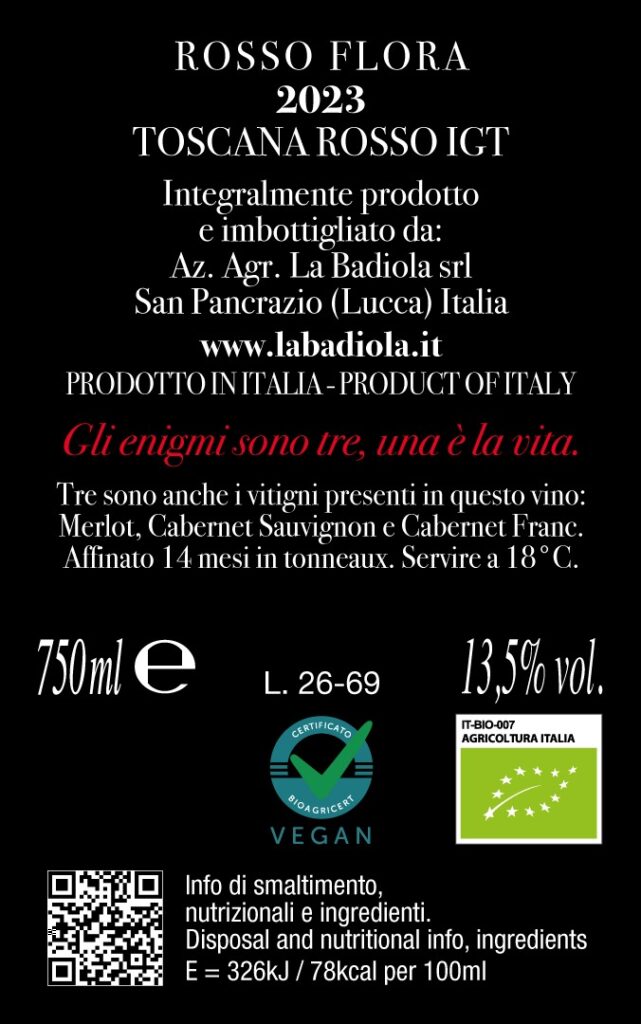
Just as the princess poses three riddles with a single true stake, Turandot too is born from the meeting of three grape varieties: Merlot, Cabernet Sauvignon, and Cabernet Franc, aged 14 months in tonneaux to create a single soul, complex and enveloping. Three different grapes, like three different riddles, blending into one result: just as "one is life," for Turandot one could say that one is the soul of the wine born from their union.
A glass of Turandot, served at 18°C, thus becomes a small tribute to Giacomo Puccini and his heroine: an invitation to be captivated, like Calaf, by the allure of what seems unreachable, and to discover that behind every riddle there is always something authentic waiting to be savoured to the very last drop.